

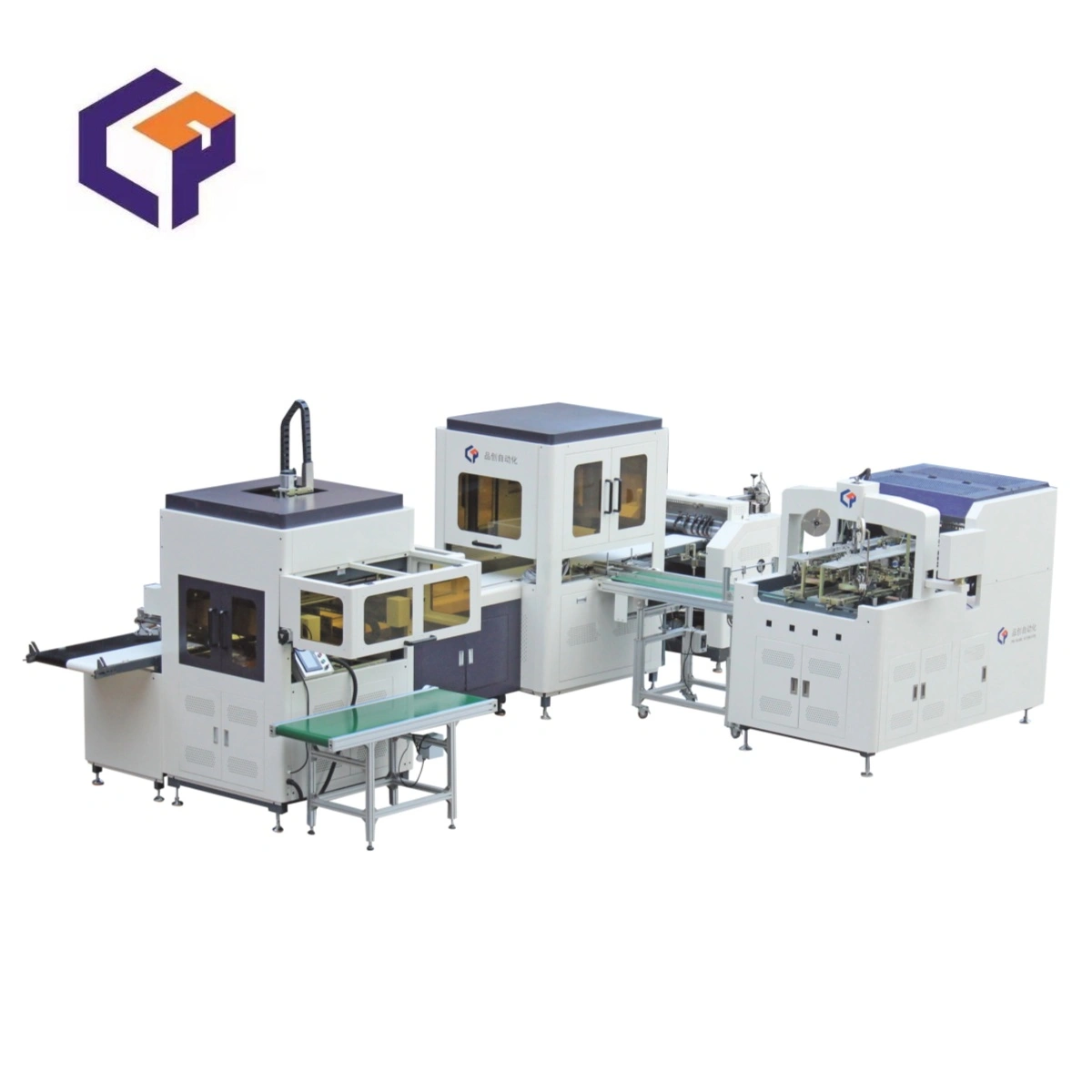
An automatic rigid box making machine takes gluing, wrapping, corner pasting and forming — steps that used to sit on separate benches with a person standing between each one — and runs them as one continuous flow. What changes on the shop floor is not only speed. The number of times a box is touched by hand before it is finished drops to almost zero, and that single change is what everything else follows from.
At Pinchuang, we have been building rigid box making machines in Dongguan since 2008, and most of the factories we walk through are somewhere between a manual bench and a full line. This guide covers what actually changes when an automatic machine takes over, where the payback shows up first, and — just as important — what still needs a person standing at the machine.
What Changes on the Shop Floor When an Automatic Rigid Box Making Machine Takes Over
The first thing that changes is not a number. It is the layout. On a manual bench, greyboard, glued wrap and half-formed boxes travel between workstations, and every one of those moves is a chance for the wrap to shift by a millimetre. An automatic rigid box making machine collapses those moves into one pass through the machine, so the sheet is positioned once and stays positioned.
The second change is where alignment comes from. On a bench, alignment comes from the operator's eye and experience, and it varies between the first box of the morning and the last box of the shift. On an automatic machine, alignment comes from a mechanical stop, a servo reference or a vision system that reads printed marks. That is the difference between "this run looks good" and "this run is the same as the last one".
On a bench, grooving, gluing, corner pasting and forming each sit on a different machine, and the panel is carried between them by hand. When those stations are matched to each other inside one frame — an automatic V grooving machine at the front, a corner pasting machine in the middle and a rigid box forming machine at the end — the sequence stops being a series of operator decisions and becomes one setting.
Third, output becomes a number you can plan against. A rated figure gives you a starting point for delivery dates, and the gap between that figure and real shift output tells you how much time you lose to changeovers and setup. We usually advise buyers to measure the gap, not the peak, because the gap is what hurts a delivery schedule.
The fourth change is the labour profile. One automatic line typically replaces several bench positions, but it does not replace the skill. The work moves from "make the box" to "set the machine, check the first box, and keep the machine fed". Those are different skills, and they are learned faster than manual wrapping.
Manual, Semi-Automatic or Automatic: What Actually Differs
Most buyers are choosing between three levels rather than between "manual" and "automatic". The table below sets out how the levels differ in the ways that show up on a balance sheet and in a delivery schedule.
| Factor | Manual bench | Semi-automatic | Fully automatic |
|---|---|---|---|
| Planned output | Depends on operator pace | Steady but lower | A rated range you can schedule against |
| Box-to-box consistency | Varies through the shift | Better on the glued and wrapped panel | Held by mechanical or vision reference |
| Operators per line | One per station | One per module | One to feed and check |
| Changeover | Immediate, no setup | Moderate — one module at a time | The real bottleneck — plan it |
| Rework on premium wraps | Frequent | Occasional | Rare, and caught early |
| Best fit for | Samples, short runs, unusual shapes | Mixed product ranges | Repeat orders at volume |
The pattern that comes out of this table is not "automatic is always better". It is that automatic wins wherever the same box is made again and again, and manual wins wherever every order is a different shape. Most packaging plants end up with both.
Where an Automatic Machine Pays Off First
When a factory asks us where to start, we look at the order book before we look at the machine. Four situations usually justify going automatic first.
- Repeat orders of one box size. Running the same size for days at a time is where the machine's consistency turns directly into fewer rejects. The setup cost is paid once and then amortised across the run.
- Premium wraps where rework is expensive. Once the wrap is textured, laminated or printed with a tight register, a misaligned box cannot be repaired cheaply. Vision-guided alignment pays for itself on the wrap alone, which is why we fit a visual positioning machine on the configurations aimed at cosmetics and gift packaging.
- Export orders with fixed delivery windows. A container does not wait for a bad week of manual output. A rated machine speed lets you commit to a date and then defend it.
- Where skilled wrapping hands are hard to hire. The shortage of experienced manual wrappers is the reason many of our customers move earlier than their order book alone would suggest.
It is worth saying plainly: if a plant makes mostly one-off sample boxes in unusual shapes, an automatic line will sit idle. Automatic machines reward repetition.
The Two Configurations Most Factories Compare
On our rigid box platform, the choice usually comes down to two machines that cover the same box range but are built for different order profiles. PC-5040A is the high-speed configuration, arranged around two-piece box forming; PC-5040B is a basic fully automatic line that brings corner pasting, box forming and positioning together on one platform. Both handle greyboard from 1 mm to 3 mm, wrap paper from 80 to 200 g/m², boxes from 65 × 65 × 15 mm up to 500 × 400 × 120 mm, and both hold ±0.1 mm positioning precision. The published output range is 26–40 pcs/min on the A configuration and 16–25 pcs/min on the B configuration.
For scale reference, Pinchuang builds this equipment in a 10,000 m² facility in Dongguan with more than 100 employees, and the machines ship to over 30 countries. We exhibit regularly at All in Print China, Printing South China, China Print, Drupa, SINO FOLDING CARTON and WEPACK, and the question we hear most from export buyers is not about peak speed. It is about whether the machine repeats the same setting after every size change.


What Still Needs an Operator
"Automatic" does not mean unattended, and any supplier who tells you otherwise has not spent a shift on the line. Five tasks stay with a person.
- Loading and topping up. Board stacks and wrap stacks run out. Someone has to keep them full, and the machine stops the moment they are not.
- Approving the first box after a changeover. The machine will run whatever it is set to. Confirming that the setting is right is a human judgement, and it is the cheapest quality gate in the plant.
- Glue checks. Viscosity drifts with temperature and with a new batch of adhesive. A two-minute check at the start of a shift prevents a whole pallet of lifting corners.
- Wrap and material changes. Switching to a different printed wrap or a heavier textured paper is a setting change, not a push of a button.
- Maintenance and wear parts. Blades, rollers and tape heads wear on a schedule. Planned replacement keeps the settings valid; unplanned replacement stops the line.
The practical way to think about it is that an automatic machine moves the operator from doing the work to owning the setting. That is a smaller headcount and a more responsible job, not an empty floor.
Common Questions About Automatic Rigid Box Machines
How many operators does an automatic rigid box making machine need?
Usually one to two per line: one to keep board and wrap supplied and one to check output and manage changeovers. A fully automatic line with automatic feeding needs fewer hands than a semi-automatic arrangement of the same capacity, but it always needs someone accountable for the setting.
What is the difference between semi-automatic and fully automatic?
A semi-automatic setup is a set of separate modules — for example an automatic paper gluing machine followed by a separate forming unit — with product moved between them. A fully automatic machine links the stations so the panel travels through without being handled. The practical difference is the number of times the wrap can shift, which is the number of times quality can drift.
How long does a box size changeover take?
It depends on how many stations have to be re-set and whether the tooling is pre-prepared. The honest answer is that changeover, not rated speed, is where a plant loses its capacity, and it is worth asking a supplier to demonstrate a changeover on your own box rather than quoting a number.
Can one automatic machine run both thin and thick board?
On our current platform, yes — the rigid box range covers 1–3 mm greyboard and 80–200 g/m² wrap paper. Thin decorative wraps and heavier textured papers both work, but they need different gluing and forming settings, so the machine must be re-set between them rather than simply run through.
If you are weighing up a new line against your current bench setup, send Pinchuang your box samples and a typical monthly order profile. We will tell you which automatic rigid box making machine suits the box range, and where your changeover time is likely to go.
Send us your order profile Browse the whole machine range